


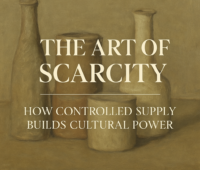
The Art of Scarcity: How Controlled Supply Builds Cultural Power
9 September 2025
In the world of fine art, as in haute horology, scarcity is not a flaw—it’s the feature. The fewer there are, the more we want them. While some markets suffer from oversaturation and speculative churn, others thrive precisely because supply is tightly controlled. The lesson is clear: scarcity creates cultural power, financial resilience, and a lasting legacy.
As an art adviser, I’ve seen collectors navigate both sides of this divide. Some are left holding too many works in a flooded market that has gone cold, while others, who invested in tightly controlled markets, have watched their collections grow into cultural and financial strongholds.
Scarcity as Strategy: Giacometti, Morandi, Richter
Take Alberto Giacometti. His attenuated bronze figures are icons not just because of their haunting existential presence, but because of their rarity. The Giacometti Foundation has strictly regulated casts, ensuring a finite number exists. That scarcity, combined with institutional reverence, has made his works cornerstones of major museums and blue-chip collections alike.
Giorgio Morandi offers a different model of scarcity—one rooted in deliberate repetition. His quiet still lifes, painted with infinite variation of bottles and jars, were produced in modest numbers compared to his contemporaries. This restraint has amplified their allure. For collectors, owning a Morandi is less about spectacle and more about participating in a continuum of meditative simplicity that museums consistently prize.
Then there’s Gerhard Richter. Despite being prolific, Richter has exercised a disciplined control over the release of his works. His Abstraktes Bild series, for example, is carefully managed through exhibitions and secondary sales. By controlling access, Richter has preserved both critical and market prestige, ensuring that even in a volatile market, his name remains synonymous with enduring value.
Flooded Markets: The Cautionary Tale
Contrast this with markets where production and availability have spiraled. In recent years, the contemporary art scene has been crowded with names pushed aggressively by mega-galleries. Limited early works were quickly followed by an avalanche of paintings, prints, and editions designed to meet collector demand.
Initially, prices soared. But soon, supply outstripped cultural demand. Works began to appear at every auction, every art fair booth, every secondary gallery. What once felt exclusive became commonplace. Collectors who paid six figures during the frenzy often found themselves unable to resell even at half the price. The very volume that built early hype eroded long-term value.
The Psychology of Rarity
Scarcity works because it appeals to something deeper than market logic: human psychology. When access is limited, desire intensifies. Luxury watchmakers like Patek Philippe and Rolex have long understood this principle—producing fewer watches than demand dictates, creating waiting lists that stretch for years.
Art functions the same way. A controlled market signals not just rarity, but discipline, vision, and cultural seriousness. Collectors understand that what is rare is not easily replaceable. That scarcity itself becomes part of the artwork’s aura, adding layers of desirability and prestige.
Cultural Power Through Control
Scarcity doesn’t just preserve financial value—it builds cultural power. When only a few works circulate, they tend to end up in the most significant collections and institutions. This concentration creates a feedback loop: visibility enhances prestige, prestige reinforces demand, and demand sustains value.
The Giacometti in the MoMA, the Morandi in the Tate, the Richter in the Centre Pompidou—each placement amplifies not just the individual artwork but the entire market around that artist. Controlled supply ensures that works don’t scatter indiscriminately, but instead enter contexts that elevate both reputation and price.
Advice for Collectors: Navigating Scarcity and Saturation
For collectors, understanding the dynamics of scarcity is crucial. Here are the principles I share with clients:
- Research Production Levels: Know how many works exist in a series and how many are likely to appear on the market.
- Evaluate Institutional Engagement: Artists with strong museum placements tend to benefit most from scarcity-driven markets.
- Beware Overproduction: Be cautious of artists producing at scale to meet speculative demand—it rarely ends well.
- Prioritise Emotional Resonance: Scarcity matters, but don’t neglect your own connection to the work. Desire sustained by love is stronger than desire sustained by hype.
Conclusion: Fewer is Better
In art, as in luxury, less often means more. Scarcity creates mystique, protects value, and elevates cultural significance. Giacometti’s haunting bronzes, Morandi’s meditative still lifes, Richter’s disciplined abstractions—all prove the same point: controlled supply is not just market strategy. It’s an art in itself.
For the thoughtful collector, understanding scarcity is essential. Not every market crash can be avoided, but by aligning taste with scarcity-driven strategy, you can build a collection that is as enduring as it is desirable.
Daniel Turriani